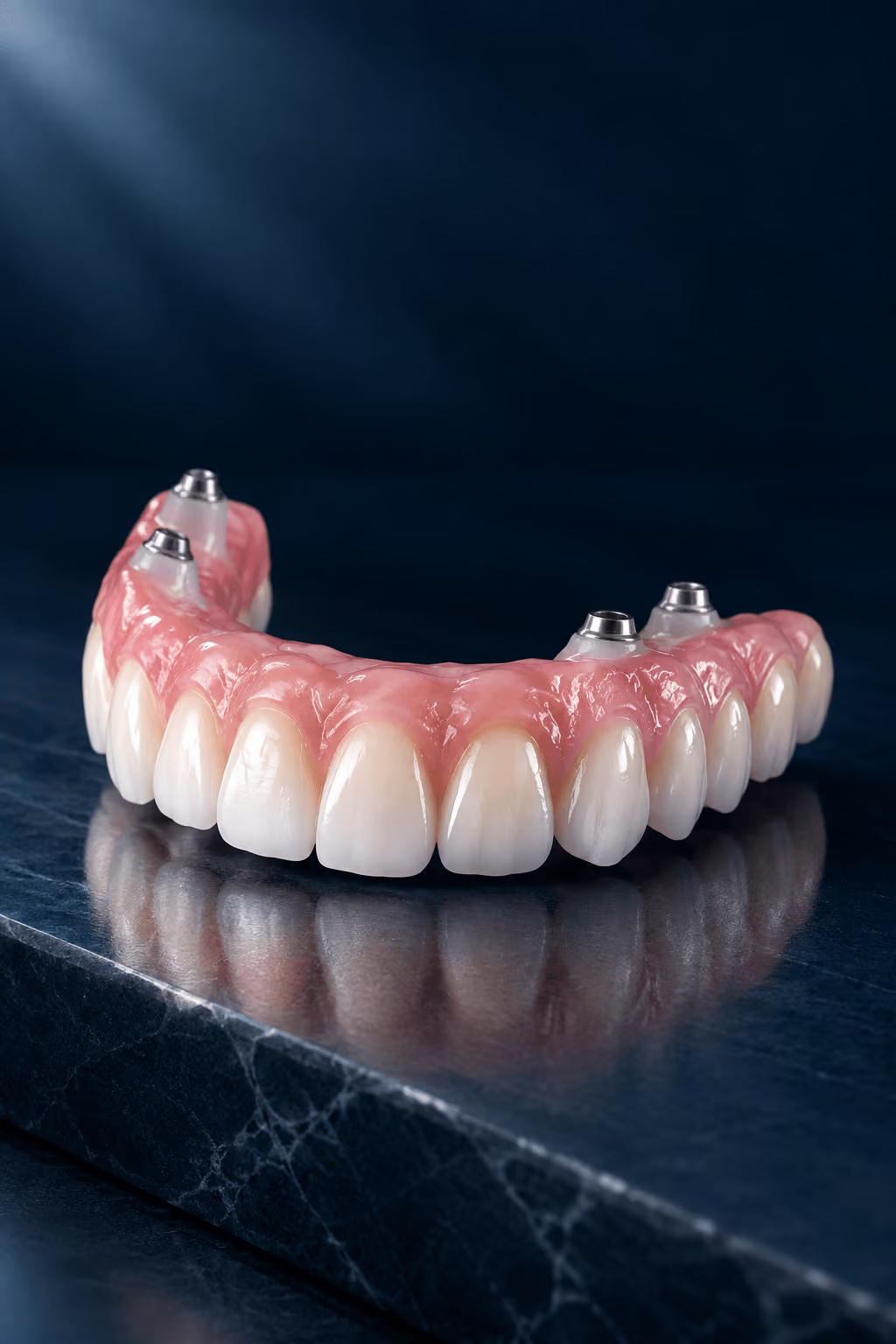
Premium zirconia implant prostheses designed for full-arch implant cases with precision, strength, and highly esthetic results.
Get Started
15–18 business days
Available — confirm case requirements with laboratory
Available — confirm required files and implant components with laboratory
Viva Dental Lab provides zirconia implant prostheses for full-arch implant cases requiring a durable, highly esthetic definitive restoration. Each case is fabricated around the patient's implant configuration and approved treatment plan, with attention to prosthetic design, occlusion, emergence, and overall esthetics.
Our catalog includes up to six multi-unit abutments and two full-arch provisional try-ins as part of the standard zirconia implant prosthesis service. Additional try-ins and multi-unit abutments can be accommodated when required.
Full-arch implant cases require close coordination between the clinical team and laboratory. Viva Dental Lab focuses on accurate case communication, careful prosthetic design, and controlled fabrication to help clinicians move from provisional evaluation to the definitive restoration with confidence.
Zirconia is used for the definitive implant prosthesis. The workflow incorporates digital case planning and CAD/CAM fabrication where applicable.
Digital implant records can be incorporated into the case workflow when provided. Implant position data, scans, and other digital records are reviewed during the design process.
Implant prostheses are inspected for design accuracy, component compatibility, occlusion, esthetics, fit, and overall fabrication quality before delivery.
Contact the laboratory before the restorative appointment when the implant system, components, digital workflow, required records, provisional design, or case-specific requirements are uncertain. Establishing the intended workflow in advance can reduce incomplete records and prevent avoidable delays during fabrication. Communication between the dentist and laboratory is particularly important for implant prosthodontic cases.
Include the existing provisional when it is relevant to the definitive restoration, along with appropriate records and clear instructions identifying what should be retained, changed, or used as a reference. Existing prostheses can provide useful information about tooth position, contours, occlusion, esthetics, and the patient's current clinical setup.
Provide the implant system, applicable connection or platform information, multi-unit abutment details when used, and any relevant component specifications. If there is uncertainty about the required components, contact the laboratory before submitting the case rather than relying on incomplete or assumed component information.
A verification or provisional stage can help confirm implant positioning, fit, occlusion, esthetics, phonetics, and other clinical requirements before the definitive prosthesis is fabricated. This is particularly important for full-arch implant restorations because errors in the records or implant relationship can affect the final prosthesis.
Yes. Viva Tech Dental Lab accepts digital scans as part of its laboratory workflow. For implant cases, the digital submission should include the records and implant-related information required for the selected workflow. Confirm scan-body, component, and supporting-record requirements with the laboratory before submission. Digital full-arch workflows can be used to capture implant positions and other clinical records, but the case must still provide enough information for verification and fabrication.
The required records depend on the case and workflow, but may include implant-position records, opposing-arch records, a stable bite or jaw-relation record, soft-tissue information, clinical photographs, and the laboratory prescription. For complex cases, confirm the required record set with the laboratory before the restorative appointment.
Provide the implant or multi-unit abutment information, applicable component or connection details, implant positions, the laboratory prescription, and the clinical records required for the planned restoration. Clearly identifying the implant system and components helps the laboratory fabricate the prosthesis using the correct interfaces.